The backlog isn't a prioritization problem. It's a unit cost problem. Here's why AI tools made your team faster but didn't shorten the backlog.
Most enterprise product teams have adopted AI tools by now. Developers are using Claude Code and Cursor, product managers are drafting PRDs with Claude, and designers are prototyping in Figma AI. Everyone is faster at their individual job. And somehow, the backlog is the same size it was a year ago.
The explanation holds up on inspection. When you speed up each step in a sequential process without changing the process itself, you reach the handoff faster. Writing PRDs and generating prototypes are faster now. But the gap between them is exactly where it was.
What most teams want to test is whether lots of small incremental improvements can deliver more business value than a few large strategic projects. The hypothesis is almost always yes. The problem is that even the small things, the backlog items that never get addressed, require moving through the same heavyweight process as everything else. Without a way to connect AI directly to the codebase and let reviews happen in context, nothing gets faster except the individual steps. The handoffs stay exactly where they were.
The four-bucket problem
Most product teams are managing work across roughly four categories at any given time:
- Large strategic initiatives that span multiple quarters
- Sprint-level enhancements
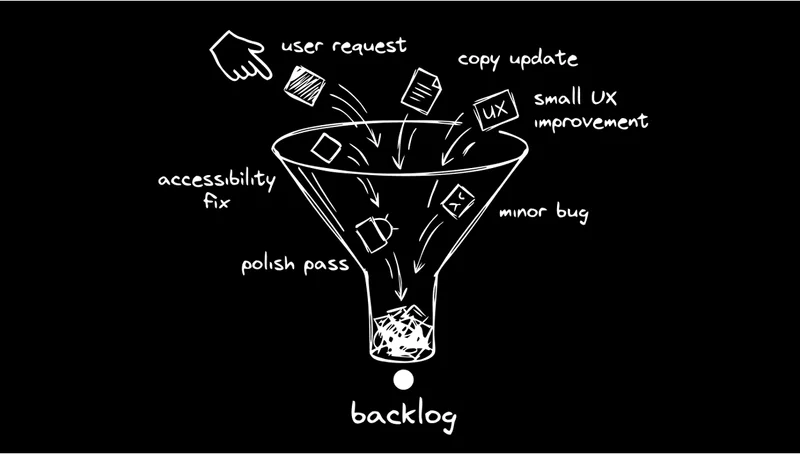
- A backlog of smaller improvements that compound into meaningful product quality over time
- Ongoing bug fixes and support
The first two get prioritized. Bug fixes only get attention when something breaks, but small backlog items rarely do.
The problem is structural. The cost of a backlog item is almost the same as that of a full enhancement. Both require a designer to create something, a developer to build it, a round of back-and-forth between them, a review cycle, and a deployment process. When the unit cost is that high, the small things never pencil out. They stay on the board indefinitely. Adding headcount doesn't solve it either.
When AI has direct access to your codebase, design system, and existing context, the unit cost of small changes drops significantly. A designer or PM can describe a change; the agent builds it in an isolated branch; a developer reviews the diff; and it ships. The infrastructure exists to handle it without consuming a full sprint. The backlog becomes addressable.

Why the tool-per-step approach falls short
The obvious response to slow handoffs is to make each tool faster. Better Figma prototyping. Faster design-to-code conversion. AI-assisted code review. These are real gains, and teams that have adopted them are measurably faster at each step. The steps are still separate, though, and the people doing them are still in separate tools.
What you end up with is four faster silos handing off to each other. Designers work visually. Developers work in code. Neither can easily contribute to the other's environment. The iteration cycle at the end, when you're trying to reconcile what was designed with what was built, stays expensive. You've just arrived at it sooner.
The gap is in connecting the generated UI to the existing infrastructure. Legacy integrations, API contracts, and backend services with documented but sprawling context. When AI doesn't have access to that context, it generates something that looks right and works in isolation but doesn't fit the actual system. A human has to catch that, and the review cycle stays as heavy as ever.
What the collaboration layer actually changes
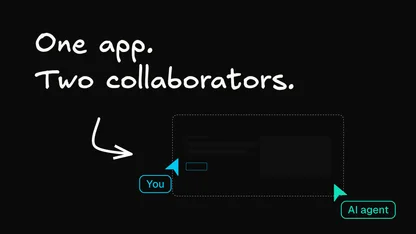
The shift isn't about replacing the tools people already use. Most developers will keep using the IDE they prefer. Designers will keep working in Figma. What changes is that there's a shared environment where the work comes together. A PM assigns a backlog ticket to an agent; the agent builds against the real codebase and surfaces a preview link; the designer refines it visually; QA validates it. The branch carries the context the whole way, and the engineer reviews a diff rather than rebuilding someone else's feedback from scratch.

AI is only as useful as the context you give it, and different types of work require different contexts. A conceptual prototype needs very little. A high-fidelity prototype heading toward production needs to meet accessibility standards, meet compliance requirements, address geo-specific constraints, and be informed by the service architecture behind it. The workflow has to reflect those differences, not flatten them.
The agent opens a PR. A developer reviews it. A designer confirms the visual output. The work that used to sit in the backlog for quarters is shipped in days. The strategic work doesn't get crowded out because the small things are no longer competing for the same resources.
The real leverage is in the process, and that's what actually moves the backlog.
Builder connects to your existing codebase, design system, and git workflows so every role on your team can build, review, and ship together. Sign up for a free trial.