AI Won't Save Your Development Process. Rebuilding It Will.
The entire modern software lifecycle was built around one fundamental solution: writing code is extremely slow and expensive. So every habit that followed made sense. Design before building. Specs before coding—stakeholder alignment before a developer writes a single line. Protect the code from uncertainty at all costs.
Then you ship. Adoption misses. Features that seemed obvious in a PRD confuse real users. You gather feedback, replan, and run the loop again. The process didn't fail you. It did exactly what it was designed to do: minimize the risk of writing wrong code in a world where code was expensive. That world no longer exists.
The bottleneck was never the code
AI systems can now turn ideas into working code in seconds. Anyone can direct them, though today, mostly only developers do so on real production systems.
The step that used to limit everything now moves faster than the rest of the workflow. And yet most teams changed almost nothing. They inserted AI into the coding phase and left the surrounding process intact. The flow still looks familiar: plan, design, spec, meet, then code.

Here's what the data says about that approach:
- AI coding makes developers about 26% faster (MIT)
- Coding is only 16% of a developer's week (IDC/Atlassian)
- Active work is only 15 to 25% of the idea-to-production timeline; the rest is waiting in queues and handoffs (Scrum)
You're speeding up a fraction of the process. Delivery barely moves. The constraint shifted. The workflow did not.
Customers are the only honest stakeholders
Teams always think they know what customers need, but rarely actually know (beyond the superficial). We have research, intuitions, and internal discussions. Those inputs matter, but they're still guesses. Documents, design reviews, and stakeholder meetings create the illusion of clarity without actual proof. Often, they produce something worse: design by committee, which satisfies internal participants but not actual users.
None of that tells you how someone behaves when a feature appears in front of them. Only usage does.
The best marketing teams have known this for years. You don't debate copy for hours in a conference room. You ship an A/B test, measure what works, learn, and move forward. That discipline wasn't really available to product teams before, because building and rebuilding software took too long. Now it isn't.
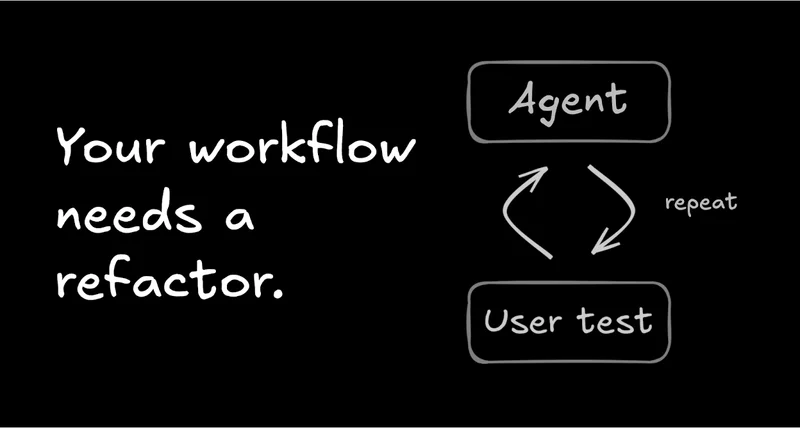
The core loop is simple: build, put it in users' hands, collect feedback, improve.

Everything outside that loop is assumption management.
What AI-native development actually looks like
AI-native development is not "the same process, but developers code faster." It's a different operating model entirely.
Instead of ending with code, you begin with code. A ticket, Slack message, bug report, or customer request enters the system, and an agent turns it into a working improvement in near real time. That's not the end of the work. It's the start of the only part that matters: feedback on something real.
Designers adjust the interface by working directly with the agent and seeing changes in the product. QA describes issues and verifies fixes immediately. Product managers send a working link to stakeholders and customers rather than asking them to respond to a document. Sales teams show early versions during live conversations. Support teams turn recurring complaints into concrete changes. Anyone on the team can start an iteration.

The constraint stops being developer availability. It becomes the quality of feedback the organization gives. That's a better bottleneck because feedback can come from everyone at once, and every cycle improves the product rather than extending the queue.
This is how we build at Builder. Customer feedback becomes a live product improvement, often within a day. A Slack message turns into a shipped change, same day, regularly. Not a goal. The actual operating model.
If you want agent workflows limited to developers, Cursor and Claude Code are good options. If you want prototypes kept separate from your real product, Lovable and Replit are useful. If the goal is real product, real data, and collaboration across product, design, and engineering, Builder is built from the ground up for this workflow.
The work developers actually want to do
Developers don't disappear. Their work gets better.
In the old model, engineers sat between every idea and working software. A large share of their time went to small changes: interface tweaks, copy updates, reversals of earlier decisions, low technical value, and high interruption cost.
AI-native teams move those loops out of the engineering queue. Engineers focus on the problems that actually require them:
- Architecture
- Distributed systems
- Performance and reliability
- Security and data integrity
- Code quality and maintainability
While agents handle surface-level iteration, developers protect the foundation. The work gets more technical. The leverage increases.
Quality control at agent speed
Parallel agents raise an obvious question: who verifies all of this?
Not chaos. Not lower quality. Structured review before engineering ever sees it. We built this into Builder specifically because teams without this layer get buried fast.
When an agent produces a change, it routes through checkpoints before a developer reviews the code:
- Product approval confirms alignment with the intended outcome
- Design approval verifies experience quality
- QA verification tests functionality and edge cases
- Automated tests run across the codebase
By the time a pull request reaches an engineer, most validation is already completed. A review agent assists throughout, analyzing the original request, examining the generated code, identifying likely failure scenarios, testing paths and edge cases, and automatically sending corrections back to the coding agent. Engineering review becomes the final checkpoint, not the first. The main branch stays sacred. Faster generation should never mean a lower bar for production.
The question every team has to answer
Three things changed at the same time:
- Coding agents are good enough that non-developers across the organization can direct them
- The cost of writing code keeps falling
- Parallel development is now operationally viable at scale
Every software team faces the same decision: keep running a process built around outdated constraints, or build a system around rapid experimentation and continuous feedback.
The teams that get this right will out-ship everyone else. Not because they hired better engineers or grew faster. Because they stopped treating planning as the product and started treating customer feedback as the only signal that matters.
The only way to know a customer will be happy with something is to get it in their hands before it ships, not after months of internal alignment.
The agent-driven development workflow
At Builder, every idea starts with an agent. The agent produces a working change within minutes. The team reviews something real instead of debating a plan.
Designers review the interface. PMs assess product impact. QA checks behavior. Engineers review the code. Customer feedback moves straight into the product. A support report in the morning becomes a product improvement by the end of the day.
Builder exists because current tools do not support this workflow. Cursor and Claude Code place agents inside developer tools. Lovable and Replit generate prototypes that never make it to production. Builder connects the full team to the real codebase with roles, approvals, and review flows so the main branch stays protected while iteration moves fast.
That’s the model. And it works today.