As Frete's product surface area grew, its design system evolved faster in Figma than engineering teams could realistically implement in production. Designers documented clear patterns and components, but competing engineering priorities made it difficult to maintain alignment with the underlying code implementation. Over time, this created friction between what was designed and what could be shipped.
Challenge
Rebuilding a design system that couldn't keep pace with product needs
“Our process was clean in Figma but slow in code. Designers moved ahead, engineers were overloaded, and components kept getting rebuilt. We needed a workflow that let both sides deliver at the same speed.”
Without a shared, production-backed source of truth, teams often rebuilt components manually. Even small interface updates extended the back-and-forth as teams worked to reconcile design intent with technical constraints.
From the design side, this gap slowed collaboration. As César Agostinho, Lead Product Designer, explains, "We had designers who were strong visually but didn't always have the frontend context to discuss implementation details with developers. That made it harder to turn ideas into something the engineering team could realistically ship."
The impact was felt just as clearly on the engineering side. Juan Noronha, Senior Staff Frontend Engineer, recalls how long the original system took to materialize. "The first design system took two to three years to build. Designers would create the prototypes and interfaces, and then the development team would slowly implement a few components at a time."
This traditional handoff model introduced delays at every stage, making the system difficult to maintain as product requirements changed.
Limited developer bandwidth amplified the challenge. Many squads did not have dedicated frontend engineers, which meant teams often waited for availability before moving forward. As Frete continued to grow, the gap between design ambition and engineering capacity risked widening, making it harder to maintain product velocity.
When Wagner Aquino, Product Designer Lead for Design Systems, joined Frete, he immediately recognized the design-engineering gap he'd encountered at previous roles. He'd previously discovered Builder through Figma's ecosystem and followed its evolution over time. Based on that experience, Wagner knew a traditional rebuild would take too long. He saw Builder's AI-powered visual development platform as the way to close that gap from the start.
Solution
Implementing a unified design system workflow powered by Builder
“Builder allowed designers to contribute real implementation work, which helped engineers focus on advanced problems instead of repetitive components. It aligned our teams and improved the speed of our entire workflow.”
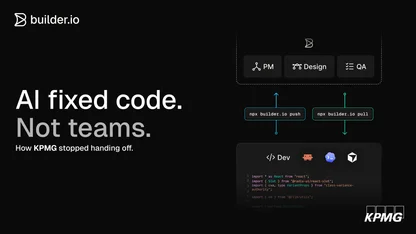
Frete implemented Builder to rebuild its design system and replace fragmented handoffs with a shared workflow. Builder connected the team's Figma files directly to production-ready components, providing designers a reliable way to create interfaces that align with technical constraints, coding standards, and the existing design system.
Using Builder's Figma import, designers generate components that preserve spacing, structure, and established patterns. This removed much of the rework caused by translating visual designs into code, giving engineers confidence that what appeared in Figma would translate cleanly into production.
Builder's GitLab integration introduced a workflow where designers generate components and engineers review them through pull requests. From an engineering perspective, this marked a meaningful shift in their workflow.
As Juan Noronha explains, the team began to see designers contributing implementation-ready code rather than handing off static designs. "Instead of engineers rebuilding UI components from scratch, we now review and refine what designers generate. That lets us spend more time on complex logic and advanced parts of the application."
The team validated this improvement by comparing their previous design system approach with work completed using Builder. Designers create components that automatically generate the underlying code. Engineers review and refine rather than manually implementing from prototypes. This shift demonstrated clear gains in both speed and consistency.
After initial success with Builder on the design system team, Frete began expanding adoption across the broader design organization. As César explains, "We are focused on sharing this knowledge so that other designers can propose things with Builder."
By spreading this capability, Frete aims to maintain delivery velocity even when engineering teams are focused on core product features, reducing dependency on limited developer availability.
Builder also enables the quick testing of components. Designers produce the initial version of a page or module in Builder, and engineers refine it through review. Instead of waiting weeks between feedback cycles, teams iterate in days, enabling Frete to continue advancing product work without compromising quality.
Results
A faster, more consistent, and more scalable design system
“Builder gives us a path to scale our design system and our product teams. As more squads use it, designers gain real autonomy, and engineers focus on the work that drives our future roadmap.”
Frete rebuilt its new design system in about three months, compared to the two to three years required for the first version. With Builder, they created a workflow that keeps design and engineering aligned, reduces negotiation, and speeds up the creation of production-ready components.
As Frete expands Builder into more product squads, the team expects to reduce engineering bottlenecks and increase design autonomy across the organization.