Your App Is Your Agent: Building Agent-Native Applications
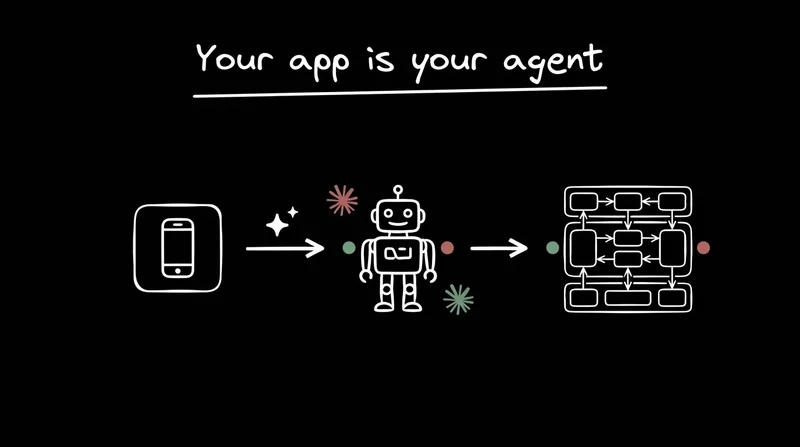
Building an agent on top of a UI-first app doubles your implementation and review load. Agent-native apps run the UI and the agent from a single set of actions.
For a decade, the argument was whether to build software mobile-first. The teams that won didn't shrink a desktop app onto a phone. They rebuilt from the ground up around the constraint of a small screen and a thumb. Instagram was mobile-native, not a mobile port, and the difference was the whole product.
The same split is happening again, and this time the constraint is the agent. Most companies are bolting a chatbot onto software that was never built for one. The agent can't see what you see, can't touch what you click, can't change the app it lives inside. It makes an LLM call and drops the result somewhere off to the side. That's a port. The native version looks different. The agent and the interface are equal citizens of the same system. Anything the UI can do, the agent can do. Anything the agent can do, the UI can do.
Today, this is no longer optional. You shouldn't ship a single new application that isn't agent-first.
The chatbot-on-the-side is a dead end
When you add an agent to a finished product, you are grafting a second brain onto a body that can't feel it. The agent gets its own path to the data and its own idea of what the app can do, separate from the buttons a user sees, and the two versions drift apart as the product grows. A feature ships in the UI that the agent never learns about, or the agent gains a capability that no button exposes.
You end up building every capability twice, once for the person and once for the model, then spending the rest of the product's life keeping the two copies honest. For a team already drowning in agent-generated PRs, adding a parallel agent surface on top of a UI-first codebase doubles the review surface at the worst possible time.
Actions are the idea that makes it work
The fix is architectural and comes down to a single abstraction. Define the application as a set of actions, discrete pieces of business logic like drafting an email or adding a task. The frontend calls those actions. The agent calls those same actions its tools. Build a feature once, and you get the button and the agent capability together from the same definition.
That single decision is what lets you promise "anything the UI can do, an agent can do." The promise is a property inherent in the architecture. If every capability is an action, and both surfaces run on actions, the two stay locked together, because there is only one source of truth for what the app is allowed to do. Build a feature into the front end, and the agent can use it automatically. That is what agent-first means.
You feel the difference downstream. Debugging gets simpler because one place defines what the app can do, and the app stops caring which door you come through.
Once the app is agent-native, the interface becomes a choice
Here is the part that changes how you think about products. When the agent and the UI share the same actions, the interface stops being the only way in. It becomes one option among several.
Picture building a to-do app from a single prompt, then driving it three ways without changing a line. You type into the built-in chat, and the list updates. You add /mcp to the app's URL, connect it to Claude, and manage your tasks from there. You talk to it with your voice, ask it to delete a task, and it's gone. Same app, same logic, three front ends. You can go fully headless and run the whole thing from Slack or Telegram, or keep the rich UI and switch between them on the fly as needed.
This is why "agents with faces" is a better frame than "apps with agents." An agent gives you reach, since you can talk to it from anywhere. An app gives you the things pure agents are bad at: dashboards you can save, buttons that guide a new user, permissions, and a shape to the work. Most agents get better once they have a UI, and most apps get better with an agent inside them, so the useful design goal is to have both available and let the person pick the surface that fits the moment.
The economics: Stop rebuilding the same machinery
There's a practical argument underneath the philosophical one. Building a good agent experience is expensive. A Claude Code fits your product needs: chat, streaming, the ability to stop and steer, permissions, memory, skills, multi-tenancy, and org management. If every team hand-rolls that for every app, the cost of agent-native software will remain high enough that most teams won't pay for it. The counterintuitive move is that the best agent-native apps lean on less AI, not more, because the work falls to deterministic actions the agent calls, which keeps a model from having to improvise parts that need to be reliable.
The answer is a toolkit of production pieces that the coding agent composes rather than writing from scratch. Ask the agent for a Notion-style editor, and it pulls a rich one out of the toolkit rather than inventing it, and you can eject it, copying the component into your own code to edit any part, the way Shadcn works. Chat, real-time editing, settings, multi-tenancy, org management, all there, already running in production apps. The same idea shows up in a set of forkable starter apps, working software you clone and let the agent evolve. The coding agent stops reinventing the wheel and starts assembling, which is the only way the pattern gets cheap enough to be the default.
A network of agents, each with a face
Follow the logic out, and the shape of software changes. If every app is defined as a set of actions, and every app speaks MCP, apps can call each other. Build a to-do agent inside a workspace, a monorepo where multiple agents discover each other and talk, and you can ask it to pull numbers from an analytics agent and write a task based on the result. The call works because, to one agent, another agent is just a set of actions to call.
The network becomes the unit that matters: a set of agents, each with an interface you can step into whenever you want, all of which stay reachable by one another. Push the idea far enough, and the boundary between "app" and "agent" starts to dissolve. Something like Salesforce becomes a UI you can clone, customize, and operate by voice, by button, or by another agent.
From pattern to practice
Owning the pattern is one thing. Getting a whole team to build on it is another. Builder sits atop your AI coding tools as the collaboration layer, enabling teams to build and ship from a single shared codebase.
- Engineers keep the coding agent they already use. The rest of the team contributes to the same project instead of waiting in a handoff queue.
- The build phase stays visible to everyone. Visibility is what makes the collaboration layer double as a control layer.
- The agent-native pattern is coming to Builder, so building these apps won't require coding.
The result is one team building one product, with agents and humans both doing real work on it simultaneously.
Try an agent-native app for free: https://www.agent-native.com/apps