Everything You Need to Know about Vite 8, Vite+, and Void
Everything You Should Know about Vite 8, Vite+, and Void
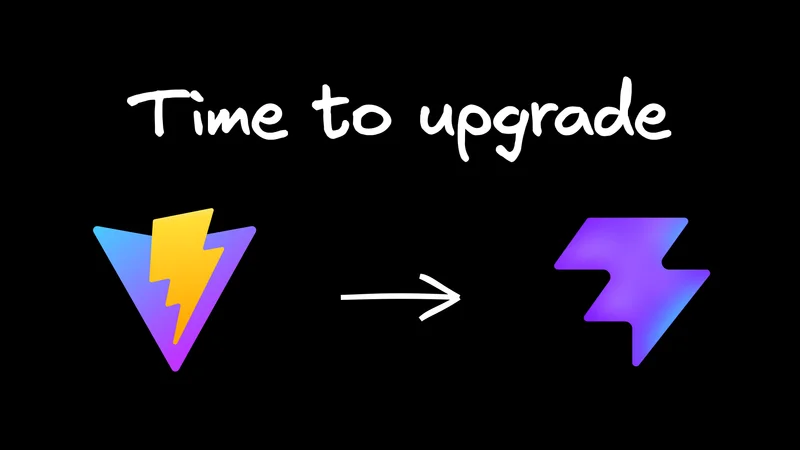
Vite just shipped its biggest changes yet.
Vite 8 brings a Rust-based core, while the company behind Vite, VoidZero, is turning the surrounding ecosystem into a fuller platform story with Vite+, a unified workflow CLI, and Void, a Vite-native deployment platform.
Here's what actually changed and what matters for your team.
What Vite 8 actually shipped

The main change in Vite 8 is a Rust-based toolchain. Vite now uses Rolldown as its bundler and Oxc for parsing and transforms, replacing the old split where esbuild powered dev and Rollup powered production.
That changes a lot in practice:
- Faster builds: Vite cites 10-30x gains in some benchmarks. Real-world results are more measured but still strong: Linear reported a drop from 46s to 6s, Ramp reported a 57% reduction, and other adopters have shared 38-64% improvements.
- Dev/prod parity: Vite no longer relies on separate pipelines for development and production, which should reduce the class of bugs where everything works in dev but breaks in production.
- A more unified toolchain: Rolldown and Oxc sit under the broader VoidZero umbrella alongside Vite, so the bundler, parser, transformer, and minifier can evolve together.
- Developer experience improvements: Vite Devtools is built in, TypeScript
pathscan be handled natively, WebAssembly SSR support is better, andemitDecoratorMetadata, which basically helps decorator-heavy frameworks understand your types at runtime, now works without extra setup. - Full Bundle Mode: an experimental dev mode for large projects that were running into limits with Vite's unbundled dev server. Early numbers suggest faster startup, faster reloads, and fewer network requests.
- More modern output defaults: Vite 8 moves the default JS target to newer browser baselines, reducing unnecessary transpilation and sometimes shrinking bundles.
This is why Vite 8 feels foundational rather than flashy. The point is less a new API and more a cleaner architecture for what comes next.
Why Rolldown matters more than the speed numbers
The speed gains are easy to focus on, but the bigger shift is architectural.
Vite 8 replaces a dual-bundler setup with a single path that behaves more consistently across environments. That gives plugin authors less surface area to support and gives framework authors a cleaner target to build on. It also creates room for tighter optimizations, since Rolldown can lean on Oxc's semantic analysis instead of passing work across loosely connected tools.
That's why many developers describe Vite 8 as a stability and future-proofing release. It's infrastructure work that makes future progress easier.
Should you upgrade?
Probably yes, but expect some friction.
Migration should be manageable for most apps, especially if you are already on a recent Vite version. The Vite team did substantial ecosystem coordination before release, including preview packages and downstream testing across major tools and frameworks, which lowers the chance of a nasty surprise.
Still, this is not a zero-effort upgrade. The most likely rough edges are:
- Plugins that depend on Rollup internals or edge-case bundler behavior
- Custom config that assumed old output or transform behavior
- Larger apps that need a staged rollout instead of a straight version jump
A good rule of thumb: if your app is fairly standard, upgrade in a branch and test it. If you rely on custom plugins, unusual build behavior, or a lot of tooling around Vite, budget time for a more deliberate migration.
What you get in return:
- Faster feedback loops, especially on large projects
- Fewer dev/prod mismatches
- Better long-term alignment with where the ecosystem is going
- A cleaner base for future Vite releases
On a small project, the gains may be nice but not dramatic. On a monorepo or a large app with heavy build times, they are much harder to ignore.
What is Vite+?

Vite+ is VoidZero's unified toolchain layer on top of the Vite ecosystem—basically, what if the Vite team shipped the workflow, not just the bundler?
Instead of stitching together Vite, Vitest, Oxlint, formatting tools, task running, caching, and deployment scripts, Vite+ puts them behind one CLI with first-class monorepo support.
In the current alpha, that includes:
- Build: Vite 8 + Rolldown
- Test: Vitest 4.1
- Lint: Oxlint
- Format: Oxfmt beta and formatter tooling
- Deploy: Void
- Task running and caching: Built in
- Library bundling and scaffolding: part of the pitch
- Monorepo support: a core use case, not an add-on
Vite+ is currently shipping in alpha as free and open source under the MIT license. The underlying projects it builds on—including Vite, Vitest, Rolldown, and Oxc—also remain MIT-licensed. Earlier announcements described Vite+ as a source-available commercial product with paid tiers, but that is now historical context rather than the current licensing model.
Why people compare it to Next.js + Vercel
The comparison is about product shape, not framework features.
Next.js + Vercel offers an integrated build-and-deploy workflow. VoidZero is assembling a similar model for the Vite ecosystem:
- Vite 8 as the build foundation
- Vite+ as the unified workflow CLI
- Void as the deployment and backend platform
That's why developers talk about Vite+ and Void together: the combined workflow is the product.
Vite+ is most useful for teams spending real time maintaining a glued-together toolchain, especially in monorepos. If your setup already works and has low overhead, the value is narrower than Vite 8's.
What is Void?

Void is VoidZero's deployment platform, built on Cloudflare Workers. The core pitch: take a Vite app, add a plugin, run a command, and deploy a full-stack app without learning infrastructure first.
What it offers:
- One-command deploys with
void deploy - Cloudflare Workers as the default runtime
- A backend SDK for KV, object storage, auth, queues, cron jobs, AI, and database access
- Code-as-infra, where the platform detects needed resources and provisions them automatically
A few details make that more concrete. Void is designed to hide much of Cloudflare's setup complexity, and it uses Miniflare locally to simulate the Workers runtime while production runs on Cloudflare's network. That local-to-production parity is a meaningful part of the story.
Void is also aiming beyond static hosting. Its scope includes SSR, SSG, ISR, islands, Markdown-driven content, server functions, storage, and auth. In other words, it wants to be an app platform, not just frontend hosting.
The trade-off is familiar: the backend SDK is also where lock-in is most likely to show up. The abstraction is helpful when you want to move fast, but leaving later may be harder if your auth, storage, and data patterns are built around Void's APIs.
How to think about Void
The key question before adopting Void is simple: what does the exit look like?
Cloudflare Workers is a credible foundation. The bigger risk is the convenience layer on top, not the runtime underneath.
That puts it in the same category as other opinionated platforms: you get speed and lower operational overhead in exchange for some portability.
Who Void makes sense for:
- Teams that want to ship full-stack apps quickly without DevOps overhead
- Projects that benefit from edge deployment or global reach
- Teams already standardizing on the VoidZero stack
- Greenfield products where speed matters more than maximum portability
Who should wait:
- Teams with stable infrastructure that already works well
- Projects where lock-in or multi-cloud flexibility is a hard requirement
- Larger organizations waiting for more documentation, case studies, and production proof
- Teams that prefer direct control over cloud primitives instead of a higher-level platform layer
My take on all the new Vite stuff
I'm excited about the obvious parts: better performance, less dev/prod weirdness, and a more coherent Rust-based toolchain.
But I'm also paying attention to the bigger platform story. Vite+ and Void make Vite look a lot more like a real alternative to the Next.js + Vercel stack, especially with Cloudflare Workers underneath.
That's the interesting part, but it's also where I get more cautious. The familiar questions are still there: lock-in, more ecosystem control sitting under VoidZero, and the fact that Vite+ and Void are still early products. So my take is positive, but not naive.
Why this matters beyond Vite users
Part of why I'm paying attention to all this is that Vite is no longer just a tool for teams that explicitly choose Vite. It now underpins a growing share of modern JavaScript frameworks and tooling.
SvelteKit is aligning with Vite 8. Nitro is leaning further into Vite integration. Ember has moved toward Vite-based builds. And the Environment API is making multi-runtime setups more realistic. So when Vite changes at this level, the effects spread far beyond Vite's direct user base.
That's why Vite 8 feels bigger to me than a typical major release. It is infrastructure work for a broad slice of modern frontend development.
Should you care about all this?
Here's the practical summary:
- Vite 8 upgrade: Probably yes. The gains are real, migration looks manageable, and the architectural cleanup matters even if the headline features do not.
- Vite+: Maybe. Evaluate it if toolchain sprawl, caching, and monorepo complexity are costing your team time.
- Void: Watch closely. It looks promising for greenfield full-stack apps, but it is still early and the escape hatches matter.
If you take one action now, test the Vite 8 upgrade on a real project. That's the lowest-risk, highest-confidence move.
Vite+ and Void are more strategic bets. They may be great fits for some teams, but do not adopt the whole stack on hype alone. Measure the speed gains, assess the workflow improvements, and stay honest about lock-in.
And if you're already working in a Vite-based project, Builder fits cleanly into that setup. You can use it for visual editing, content workflows, or design-to-code collaboration without changing your core stack, and the Vite 8 improvements still help your local workflow either way.