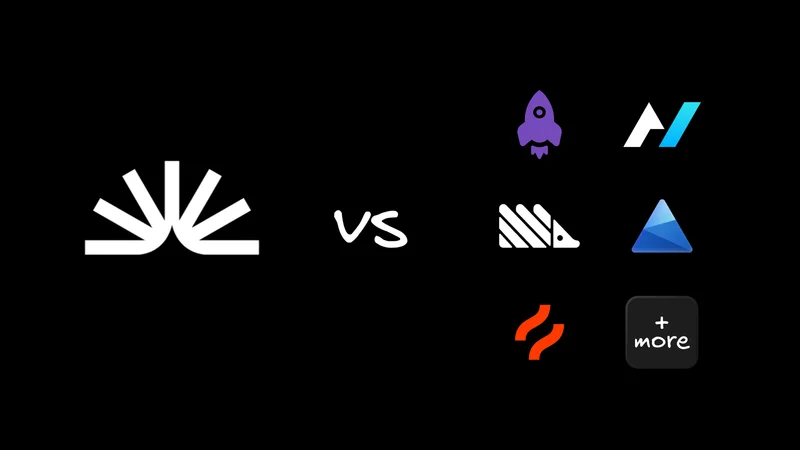
Fullstory is a genuinely good digital experience platform. It combines session replay, heatmaps, product analytics, and frustration signals like rage clicks and dead clicks in one place, and for a lot of teams that was enough for a long time.
Then the invoice shows up. Fullstory doesn't publish pricing, the paid plans run through sales, and most teams hit the same wall: it gets prohibitively expensive, the interface gets noisy at scale, and your behavioral data lives in someone else's cloud in a format you can't easily take with you.
So you start looking. The problem is that "best Fullstory alternative" means five different things depending on who's asking. A solo founder wants free heatmaps. A product team wants autocapture and funnels. An engineer wants session replay wired to real error and network data. A privacy-conscious team wants to own the data outright.
So instead of ranking ten tools 1-through-10 like they're interchangeable, I've grouped the options by the job you need to get done. Start with the table, then jump to the category that matches your problem.
If you'd rather watch than read, here's a quick look at Agent-Native Analytics, the open-source option on the list.
Quick comparison table
If you're skimming, start here. The rest of the post adds context to these columns.
| Tool | Category | Best for | Session replay? | Free / open source | Pricing model |
|---|---|---|---|---|---|
Open-source, agent-native analytics | Teams who want to own their data and query it with AI | Roadmap / not core | Free + open source | Free (self-host) | |
All-in-one product platform | Engineers who want replay + flags + experiments in one tool | Yes | Open source, generous free tier | Usage-based | |
Open-source session replay | Devs who want self-hosted replay and debugging | Yes | Free + open source | Free (self-host) / cloud | |
Free replay + heatmaps | Anyone on a zero budget | Yes | 100% free | Free | |
Heatmaps + feedback | Marketing and UX teams | Yes | Free tier | From ~$39/mo | |
Affordable replay + heatmaps | Small teams wanting Fullstory basics for less | Yes | Free tier | From ~$31/mo | |
Autocapture product analytics | Product teams that live in funnels | Add-on | Free tier | Quote-based | |
Product analytics + experimentation | PMs and data teams wanting A/B testing | Yes | Free tier | Tiered / enterprise | |
Frontend debugging + replay | Engineers chasing bugs and performance | Yes | Free tier | Tiered | |
Enterprise digital experience analytics | Large orgs quantifying revenue impact | Yes | No | Enterprise / quote |
Own your data: open-source alternatives
If the thing driving you away from Fullstory is cost plus the fact that your data sits in a proprietary cloud, this is the category to start in. Open-source tools let you self-host, audit the code, and keep behavioral data in infrastructure you control.
Agent-Native Analytics

Agent-Native Analytics is the app I'd try first if you want to actually own your analytics. It's positioned as an open-source alternative to Amplitude and Fullstory, and it's built on Agent-Native — an open-source framework from the team behind Builder.io for building apps with AI agents at their core.
The pitch is different from a traditional dashboard tool. Instead of clicking through a fixed UI, you connect a data source and prompt for what you want. The agent writes the SQL, generates the visualizations, and turns them into reusable dashboards you can re-run later. Because the whole thing is open source and forkable, you're not renting access to your own numbers — you run it.
What to like:
- Genuinely open source and forkable — the code lives at github.com/BuilderIO/agent-native, and you can self-host the whole thing for free.
- The agent writes SQL and builds visualizations from a prompt, so non-analysts can get answers without learning a query language.
- Connect any data source, build reusable dashboards, and re-run saved analyses instead of rebuilding reports every week.
- Your data and state live in your own database, not a vendor's black box.
Tradeoffs to expect:
- It's an analytics-and-dashboards tool first. Session replay isn't a documented, shipped feature today, so if pixel-perfect replay is your must-have, pair it with a replay tool below.
- Self-hosting means you own the setup — you'll need somewhere to run it and a data source to point it at.
- It's the newest option here, so the ecosystem is younger than a decade-old incumbent's.
Works well for:
- Teams who want to own their analytics stack outright and query it conversationally with an AI agent.
- Builders who'd rather fork and extend an open-source app than file feature requests with a vendor.
You can try the hosted version without installing anything, or clone the repo and run it yourself.
PostHog

PostHog is the most complete open-source alternative on this list. It bundles product analytics, session replay, heatmaps, surveys, feature flags, A/B testing, and error tracking into one platform, which means it replaces not just Fullstory but also tools like LaunchDarkly and Hotjar.
Its session replay also goes further than Fullstory's for developers — console logs, network activity, and a DOM explorer are all attached to the recording, so you can debug from a replay instead of just watching one.
What to like:
- Session replay, product analytics, feature flags, experiments, and error tracking in a single tool.
- Open source with a genuinely generous free tier (millions of events and thousands of replays per month before you pay).
- Developer-grade replay: console logs, network waterfalls, and performance data alongside the video.
Tradeoffs to expect:
- The breadth can feel like a lot if all you wanted was heatmaps.
- Self-hosting exists but the cloud is what most teams actually run.
Works well for:
- Engineering-led product teams that want one tool to ship, track, and debug features.
OpenReplay

OpenReplay is the open-source pick when session replay itself is the feature you care about. It's a self-hostable replay and debugging suite, so recordings — and the network, console, and performance data attached to them — stay on your own infrastructure.
What to like:
- Self-hosted session replay, so sensitive session data never leaves your servers.
- Strong developer tooling: network capture, console logs, state, and performance metrics tied to each replay.
- Free to self-host, with a managed cloud if you don't want to run it.
Tradeoffs to expect:
- Self-hosting replay at scale takes real engineering and storage.
- Analytics and funnels are lighter than a dedicated product-analytics tool.
Works well for:
- Privacy-conscious or regulated teams that need replay and debugging without shipping data to a third party.
Watch real sessions: free and low-cost replay
If you mostly used Fullstory to watch recordings and read heatmaps — and the price was the problem — you can get most of that value for free or close to it.
Microsoft Clarity

Microsoft Clarity is completely free session replay and heatmaps, with no session limits, backed by Microsoft. It's the simplest way to replace Fullstory's replay-and-heatmap core without touching a budget.
What to like:
- 100% free with no sampling or session caps.
- Fast to install and integrates directly with Google Analytics.
- Solid heatmaps and recordings out of the box.
Tradeoffs to expect:
- It's a visualization layer, not a data platform — no real event tracking, funnels, or product analytics.
- It's free because Microsoft uses aggregate data, so be clear in your cookie and privacy policy.
Works well for:
- Startups, side projects, and any team that wants replay and heatmaps at zero cost.
Hotjar

Hotjar is the marketer- and designer-friendly option, pairing heatmaps and recordings with on-page surveys and feedback widgets. It's now part of Contentsquare, but it still ships as an accessible standalone product.
What to like:
- Heatmaps, recordings, surveys, and feedback polls in one approachable UI.
- Built for non-technical teams — you don't need an engineer to get value.
- A free tier plus paid plans starting around $39/month.
Tradeoffs to expect:
- Lighter on quantitative product analytics than Heap or Amplitude.
- Higher-traffic sites can hit plan limits quickly.
Works well for:
- Marketing and UX teams focused on qualitative insight and quick feedback.
Mouseflow

Mouseflow is the "Fullstory basics for less" option that keeps coming up in practitioner threads. It covers recordings, heatmaps, funnels, and form analytics at a price that starts around $31/month.
What to like:
- The core replay-and-heatmap feature set at a noticeably lower price point.
- Friction scoring and form analytics to surface problem areas automatically.
- Lightweight enough that it's unlikely to fight with your site's JavaScript.
Tradeoffs to expect:
- The UI is less polished than Fullstory's, which is part of why it's cheaper.
- Not the tool for deep product analytics or experimentation.
Works well for:
- Small teams that want Fullstory-style recordings and heatmaps without the enterprise invoice.
Analyze behavior: product analytics
If you leaned on Fullstory for funnels, retention, and "which cohort did what," you were really using it as a product analytics tool. These options do that job better.
Heap

Heap is the closest match to Fullstory's autocapture model. It records every interaction automatically and lets you define events retroactively, so you're not stuck having tagged the wrong things three months ago. Heap was acquired by Contentsquare in December 2023 and now sits inside its broader experience-intelligence suite.
What to like:
- Autocapture plus retroactive event definition — no upfront instrumentation guesswork.
- A visual event editor non-technical users can actually operate.
- Managed exports to warehouses like Snowflake and BigQuery.
Tradeoffs to expect:
- Session replay is a secondary add-on, not the core strength.
- Post-acquisition, the roadmap now follows Contentsquare's enterprise focus.
Works well for:
- Product and growth teams that live in funnels, cohorts, and retention charts.
Amplitude

Amplitude is one of the original product-analytics platforms, and it's analytics-first where Fullstory is replay-first. It brings deep behavioral analysis plus built-in A/B testing and a customer data platform — things Fullstory doesn't offer natively.
What to like:
- Best-in-class funnels, retention, behavioral cohorts, and paths.
- Built-in experimentation, so you can test and measure in one place.
- A free tier to get started, with room to scale into enterprise.
Tradeoffs to expect:
- Getting full value means a fair amount of event configuration up front.
- Session replay is a newer, lighter addition compared to its analytics.
Works well for:
- Product managers and data teams who prioritize analytics and A/B testing over replay.
Debug the frontend: error and performance tracking
Sometimes "why did the user rage-click" is really "what broke in the browser." If your Fullstory sessions kept ending in bugs you couldn't reproduce, you want a replay tool built for engineers.
LogRocket

LogRocket is session replay for debugging. It ties recordings to JavaScript errors, stack traces, network requests, and frontend performance metrics, and its AI surfaces the sessions where users actually hit problems instead of making you scrub through hundreds.
What to like:
- Error tracking and performance monitoring wired directly into replays.
- AI that flags the frustrating or broken sessions worth watching.
- Product analytics (funnels, paths, retention) alongside the debugging tools.
Tradeoffs to expect:
- It's engineer-oriented; less of a fit for pure marketing use.
- Pricing climbs as session volume grows.
Works well for:
- Engineering and support teams that need to connect user frustration to the exact bug behind it.
Scale across teams: enterprise digital experience analytics
If you're outgrowing Fullstory in the other direction — billions of sessions, many teams, revenue on the line during peak traffic — you're shopping in the enterprise digital experience analytics (DXA) tier.
Quantum Metric

Quantum Metric is purpose-built for enterprises. It auto-captures hundreds of dimensions from day one, runs on cloud-native architecture designed for peak traffic, and its Felix AI acts as an always-on analyst that quantifies the revenue impact of each issue.
What to like:
- Enterprise-grade scale with true web-and-mobile parity.
- Tagless auto-capture with remote configuration — less engineering upkeep.
- AI-driven insights that tie friction directly to dollars.
Tradeoffs to expect:
- Sales-driven, quote-based pricing with no free tier.
- Overkill (and over-budget) for small product teams.
Works well for:
- Retail, travel, and financial-services orgs where a single friction point can cost millions.
Which Fullstory alternative should you choose?
Match the tool to the job, not the other way around. My recommendations:
- Want to own your data and query it with AI? Start with Agent-Native Analytics — it's open source, forkable, and free to self-host.
- Want one open-source tool that does replay, analytics, and feature flags? Go with PostHog.
- Care most about self-hosted session replay? OpenReplay is the pick.
- On a zero budget? Microsoft Clarity gives you replay and heatmaps for free.
- Marketing or UX focused? Hotjar — or Mouseflow if you want the basics cheaper.
- Living in funnels and cohorts? Heap for autocapture, Amplitude if you also want A/B testing.
- Chasing frontend bugs? LogRocket connects replay to the error behind it.
- Enterprise scale with revenue on the line? Quantum Metric.
The best Fullstory alternative is the one that fits the problem that drove you to leave — and, increasingly, the one that lets you keep your data instead of renting it back.
Frequently asked questions
What is the best free Fullstory alternative?
Microsoft Clarity is the best fully free option for session replay and heatmaps, with no session limits. If you want free and open source that you can self-host, look at Agent-Native Analytics for analytics and OpenReplay for session replay, and PostHog offers a generous free tier that combines both.
Is there an open-source Fullstory alternative?
Yes. Agent-Native Analytics is an open-source, agent-native alternative to Amplitude and Fullstory that you can fork and self-host. PostHog is open source and combines analytics with session replay, and OpenReplay is an open-source session-replay tool built for developers.
Why do teams look for Fullstory alternatives?
The most common reasons are cost (Fullstory doesn't publish pricing and runs through sales), wanting to own or self-host their data rather than keep it in a proprietary cloud, needing capabilities Fullstory lacks natively like feature flags or error tracking, and finding the interface too complex or noisy at scale.
Does Fullstory have a free plan?
Fullstory offers a limited free plan and a 14-day trial of its Business edition, but its full paid pricing isn't public and requires contacting sales. For predictable or zero cost, most of the alternatives here — especially Clarity, PostHog, and the open-source options — are easier to budget for.
What is the best Fullstory alternative for developers?
For debugging, LogRocket and PostHog attach console logs, network data, and errors to each session replay. For self-hosted, developer-owned replay, OpenReplay is the strongest choice, and Agent-Native Analytics lets engineers query their own data with an AI agent instead of a fixed dashboard.