A Better Way to Work With Number and Date Inputs in JavaScript
valueAsNumber
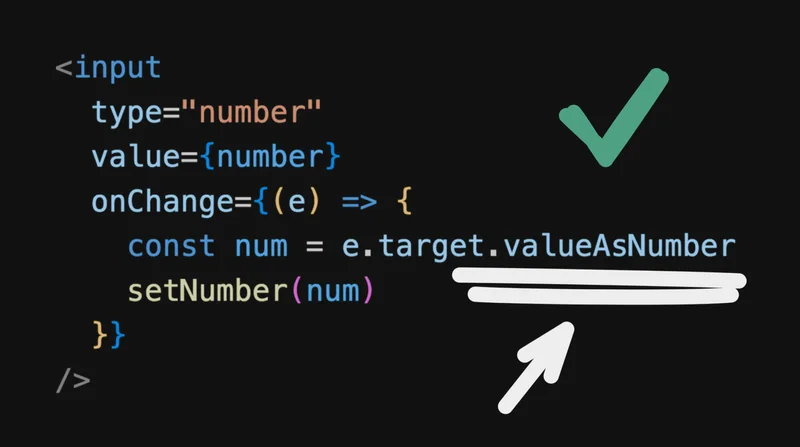
You may have written some code like this before:
This is fine and dandy, but there is actually a better way we can be reading the number value.
I’m talking about this part:
That’s right. Since all the way back in the days of IE10 we’ve had a better way to get and set number values:
So a nicer solution to the above could instead look like:
And of course, you don’t need React to use this. This is just standard JavaScript that works with any framework.
You could likewise query a DOM node and use it as well:
And, importantly, you can write to it as well!
A minor gotcha
The type of valuseAsNumber will always be a number. So this means that if there is no current value set for the input, you will get NaN as the value.
And don’t forget…
Yeah, one of those little JavaScript fun parts. So be sure to check if your valueAsNumber is NaN before writing it to places that expect actual numbers
valueAsDate
But wait, there’s more!
For date inputs, we also get a handy valueAsDate property as well:
Beautiful.
And for those who don’t use React (or Qwik, which looks like React but has much better performance), you can of course do this with any plain ole HTML and JavaScript too:
And, as expected, you can write to it as well
No gotchas this time
Thankfully, for valueAsDate, when the input is empty, we simply get null.
So you can simply check for if the value is truthy
Browser Support
Yeah, this is not a new thing at all. Even if this may be your first time learning about these properties, they’ve existed for many years, even since the dinosaur days of IE 10.

Source: MDN
Conclusion
Now that we know how, we actually treat number and date inputs as proper number and date values, using the valueAsNumber and valueAsDate properties, respectively.